Why GPUs Power Modern AI: The Engine of Intelligent Tech
Why GPUs Power Modern AI: The Engine of Intelligent Tech
When AI Needed More Power Than CPUs Could Give
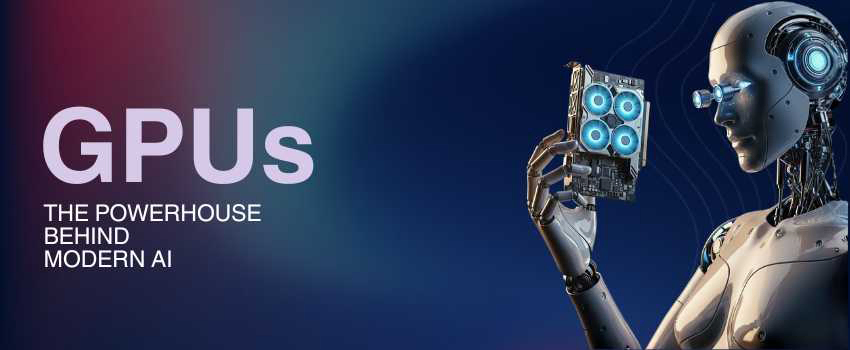
Artificial Intelligence is everywhere today, from voice assistants to smart recommendations and advanced medical tools. But behind all this progress, there is a powerful piece of hardware quietly doing the heavy lifting. That is the GPU, or Graphics Processing Unit.
GPUs were not originally built for AI. They were designed to handle graphics for games and visual applications. Over time, their ability to process large amounts of data quickly made them a perfect match for AI workloads. What started as a tool for rendering images slowly became the driving force behind modern machine learning and deep learning systems.
Why CPUs Couldn’t Keep Up
For years, CPUs handled most computing tasks. They are great at managing different operations and handling tasks one after another. But AI does not work that way. Training AI models involves repeating millions or even billions of calculations.
This is where CPUs struggled. They process tasks step by step, which makes large AI workloads slow and inefficient. As models grew more complex, the limitations became more obvious. The need for something faster and more efficient pushed researchers to look for alternatives.
How GPUs Changed the Game
GPUs approached the problem differently. Instead of focusing on one task at a time, they can handle thousands of operations simultaneously. This ability to work in parallel made them incredibly effective for AI.
Deep learning relies heavily on mathematical operations, especially matrix calculations. GPUs are naturally good at this kind of work. They can process large chunks of data at once, which reduces training time and improves performance.
This shift marked a turning point. AI systems that once took weeks to train could now be developed much faster. Suddenly, experimenting with complex models became more practical.
The Breakthrough Moment That Accelerated Everything
A major milestone came in 2012 with a model called AlexNet. It used GPUs to compete in an image recognition challenge and delivered results that were far better than anything seen before. More importantly, it achieved this in much less time.
This moment changed how researchers approached AI. GPUs quickly became the standard for training models. Tech companies began investing heavily in GPU technology, and cloud platforms started offering GPU-powered computing to businesses and developers.
What was once limited to high-end labs became accessible to a much wider audience.
Why GPUs Still Lead in AI Today
Even now, GPUs remain the preferred choice for many AI tasks. Their strength lies in handling parallel operations efficiently. This is exactly what modern AI needs.
From training neural networks to running advanced language models and generating images or videos, GPUs continue to outperform traditional hardware. They are also essential for real-time applications like robotics and autonomous systems, where speed matters.
In many cases, a single powerful GPU can achieve results that would require multiple CPUs working together.
The Growing World of GPU-Powered AI
As AI continues to expand, so does the infrastructure behind it. Large data centers now rely on clusters of GPUs to handle massive workloads. Businesses use them to run AI-driven applications, while researchers depend on them for innovation.
At the same time, there is a shift happening toward local AI. With the right setup, even personal computers with good GPUs can run AI models, generate content, and support creative work. This is making AI more accessible once again.
Looking Ahead at What Comes Next
The future of GPUs in AI looks promising. As models become more complex, the demand for faster and more efficient hardware will only grow. Improvements in design, energy efficiency, and performance will continue to shape how AI evolves.
GPUs are no longer just about graphics. They are now a core part of the AI ecosystem, powering everything from research to real-world applications.
From Gaming Tool to AI Backbone
The journey of GPUs has been remarkable. What started as a solution for rendering visuals has become the engine behind one of the most important technological shifts of our time.
As AI continues to grow, GPUs will remain at the center of it all, quietly enabling the systems that are shaping the future.
Latest Posts